
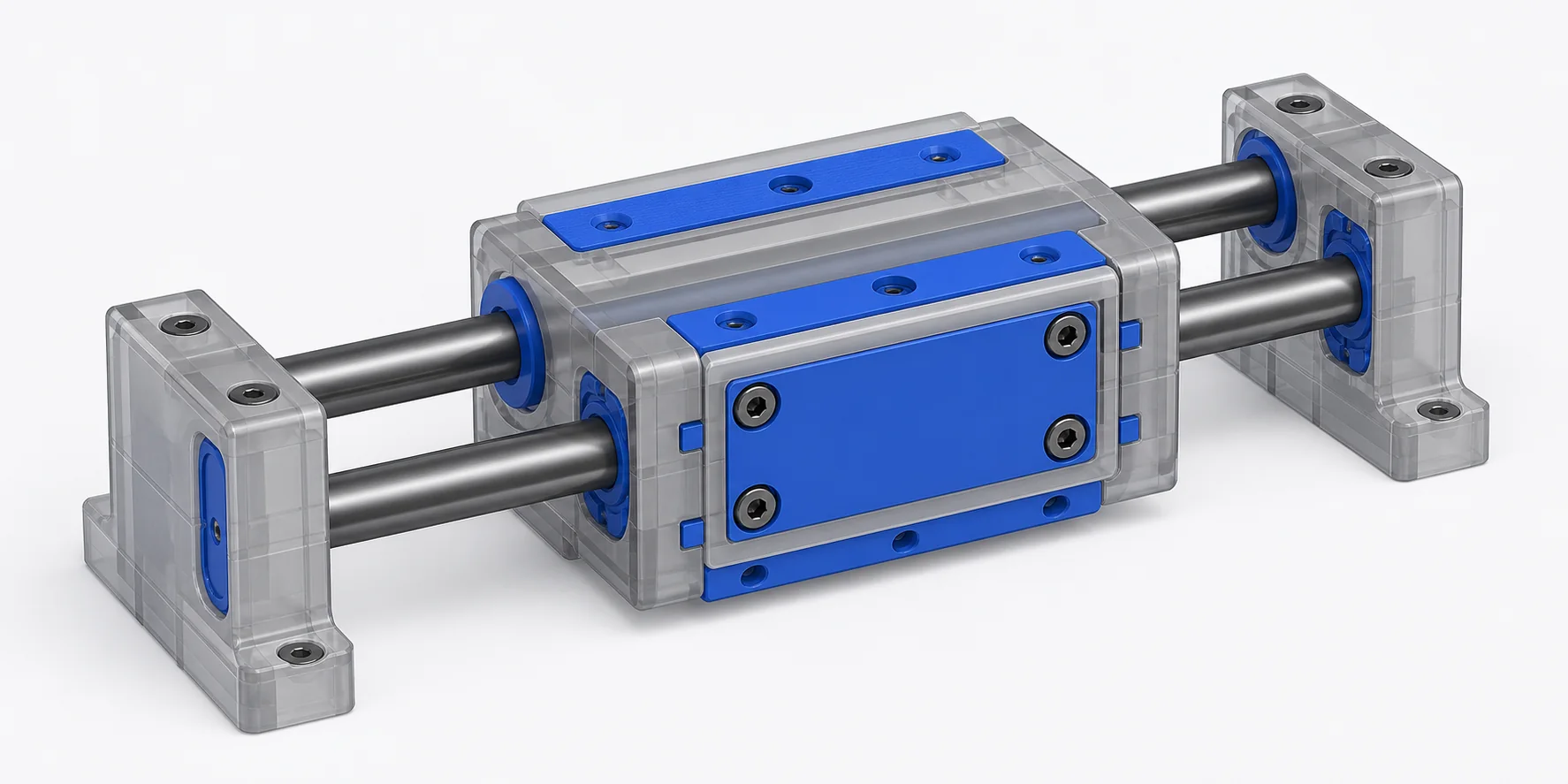
CAD visualization showing polymer bushings supporting shafts in a linear guide assembly

Sliding component solutions

Bushings and sleeves

Compare modified POM options for molded bushings affected by wear, binding, clearance drift, or housing retention. Treat the polymer, shaft, housing, fit, motion, lubricant, and environment as one sliding system.

For cylindrical, flanged, pivot, linkage, guide, and actuator bearing sleeves.

Load
Pressure and bearing length
Motion
Speed, stroke, and duty
Shaft
Material, finish, hardness
Fit
Housing and installed clearance
Environment
Heat, debris, lubricant
Target
Life, wear, and drive torque

Where this component appears

Start with the sliding-system problem.

Wear, noise, binding, or clearance change can originate in the compound, shaft, fit, alignment, contamination, or duty cycle. Diagnose the complete interface before changing material.

01
Observed problem

Rapid bore wear or growing clearance

Check first

Check bearing pressure, speed, shaft finish, alignment, temperature, contamination, lubrication, and the actual wear pattern.

Material response

Screen wear-resistant or low-friction POM only when the shaft-and-bushing interface remains the limiting factor.

02
Observed problem

Squeal, binding, or heat after assembly

Check first

Measure the installed bore, housing interference, shaft alignment, startup torque, operating temperature, and real running clearance.

Material response

Consider a friction-modified formulation only after fit, deformation, and thermal-clearance causes are separated from material behavior.

03
Observed problem

One-sided wear, scoring, or debris

Check first

Inspect the contact pattern, bore taper, shaft straightness and damage, housing distortion, seals, and the source of particles.

Material response

Compare tribological compounds only after edge loading, rough counterfaces, and abrasive contamination are controlled.

04
Observed problem

Rotation, migration, or installation cracking

Check first

Review housing tolerance, interference, lead-in geometry, insertion force, retention features, wall balance, and service temperature.

Material response

Compare balanced or reinforced POM only when assembly strain and retention geometry are already appropriate.

Candidate materials

Compare candidate materials by their response to the part.

Compare the options below against the installed fit, shaft condition, load, speed, lubrication, environment, and target life.

  1. 01

    Balanced / unfilled POM

    A baseline POM option for precision molded sleeves needing dimensional stability, moldability, useful stiffness and toughness, and stable sliding behavior.

  2. 02

    Wear-resistant or low-friction POM

    A candidate when measured wear, startup friction, stick-slip, noise, or interface temperature limits an otherwise sound bushing system.

    Project caution

    Lower published friction does not guarantee lower wear. Compare both bushing and shaft condition under the real motion and contamination profile.

  3. 03

    Reinforced POM

    A reinforced option when stiffness, creep, housing support, or load-induced deformation matters more than minimizing tribological complexity.

    Project caution

    Fiber orientation can change bore geometry, warpage, shrinkage, and counterface wear, especially in small precision sleeves.

Minimum project input

Send the project inputs already available.

A drawing and the current operating conditions are enough to begin. Remaining details can follow after the first response.

01

Part geometry

  • Drawing, bushing type, wall and flange geometry
  • Bore, outside diameter, bearing length, and critical tolerances
02

Shaft and counterface

  • Shaft or pin material, hardness, coating, and surface finish
  • Shaft diameter, tolerance, corrosion, scoring, or known wear
03

Load and motion

  • Radial or side load and load direction
  • Rotary, oscillating, or linear motion, speed, stroke, and duty
04

Housing and fit

  • Housing material, bore, tolerance, and installation method
  • Required installed clearance and retention method
05

Environment

  • Operating temperature and dry, initial-grease, or lubricated condition
  • Dust, textile fiber, water, oil, cleaners, or chemical exposure
06

Target and status

  • Current material, tooling stage, volume, and failure symptom
  • Target life, acceptable wear, drive torque, noise, and documents
Expected output

A material shortlist, available grade data or document path, and a proposed installed-bushing evaluation plan.

Validation boundary: Production approval still depends on the complete sliding assembly.

Find Grade Data & TDS

Open the detail when the project needs it.

Project input

Evaluate the complete sliding interface.

Send the drawing and available shaft, fit, motion, environment, target-life, and failure data. Taiyi Polymer can compare relevant PLATFORM POM directions, identify available grade data, and propose an installed-bushing evaluation plan.