
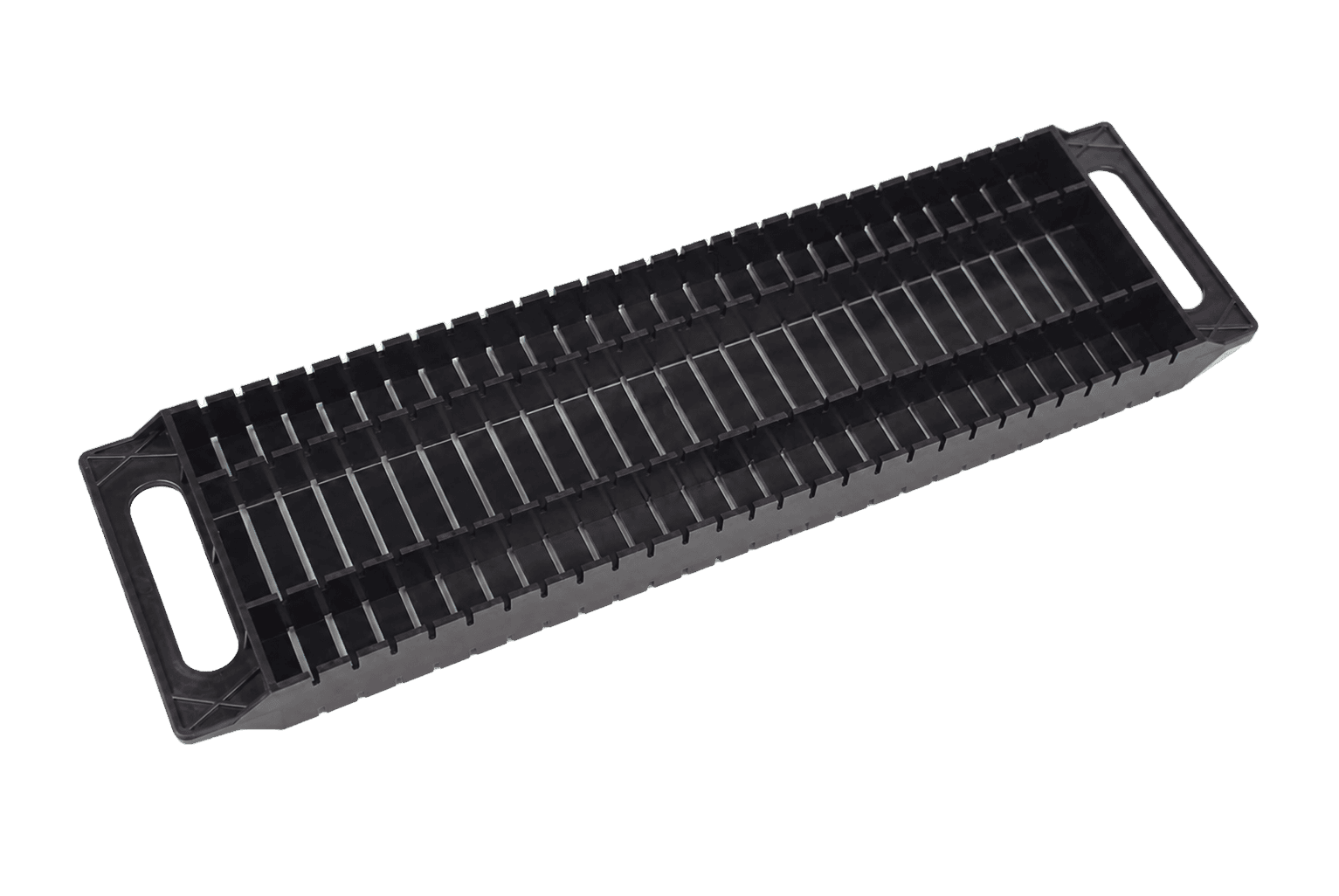
Black molded matrix tray with repeated precision pockets and stacking features

Semiconductor handling

IC handling trays

Determine whether electrically modified POM or another polymer fits a precision handling tray. Define the ESD class, process temperature, flatness, pocket geometry, cleanliness, automation, and reuse conditions together.

For matrix trays and molded carriers used to transport, store, sort, test, or present packaged semiconductor devices.

ESD
Classification and test method
Temperature
Process, duration, and cycles
Flatness
Tray outline and warpage
Pockets
Package fit and contact
Automation
Pitch, datums, and stacking
Cleanliness
Particles, wear, and reuse

Where this component appears

Start with the handling-process problem.

Pickup faults, device movement, ESD failures, particles, or warpage can originate in tray geometry, molding, conditioning, automation, handling, or compound behavior. Diagnose the complete process first.

01
Observed problem

Tray warpage or automation pickup failures

Check first

Measure complete-tray flatness, pocket matrix, datums, outline, stacking features, conditioning, gate and flow orientation, cooling, and handler calibration.

Material response

Compare dimensionally controlled or reinforced materials only when tray architecture and molding balance are already credible.

02
Observed problem

Device movement, contact, or pocket damage

Check first

Compare the full package drawing with pocket supports, terminal clearances, draft, corner relief, openings, flash, ejector witness, and loading method.

Material response

Screen a dimensionally stable molding material only after the pocket architecture protects the actual semiconductor package.

03
Observed problem

ESD classification or charge-control failure

Check first

Define the applicable standard, electrical classification, conditioning, measurement locations, protected area, grounding or contact arrangement, humidity, and reuse state.

Material response

Evaluate conductive or static-dissipative POM only as a molded-tray system with verified electrical continuity and stability.

04
Observed problem

Particle contamination or surface degradation

Check first

Identify filler or surface transfer, flash, trimming debris, damaged pockets, wear, cleaning effects, thermal exposure, and external handling sources.

Material response

Compare cleaner formulations or another material path only after the particle source and qualification limit are defined.

Candidate materials

Compare candidate materials by their response to the part.

Compare the options below against the ESD class, temperature window, flatness, pocket geometry, cleanliness, automation, and reuse conditions.

  1. 01

    Conductive or static-dissipative POM

    The primary POM option for trays that directly handle ESD-sensitive devices when its validated thermal window suits the process.

    Project caution

    Resistance, charge behavior, filler cleanliness, flow, shrinkage, flatness, pocket dimensions, wear, and reuse stability require molded-tray qualification.

  2. 02

    Dimensionally controlled or reinforced POM

    A reinforced option when tray stiffness or long-span deformation limits an otherwise suitable lower-temperature POM system.

    Project caution

    Flow orientation can create directional shrinkage and warpage and can change ESD behavior or the surface exposed to the semiconductor.

  3. 03

    Unfilled POM for non-ESDS fixtures

    An option for mechanical dividers, alignment parts, or associated handling components that do not directly require ESD control.

    Project caution

    Conventional unfilled POM is not a default ESD-tray material; direct ESDS handling requires a verified electrical specification.

  4. 04

    PPA or another high-temperature option

    A separate path when process temperature, duration, loading, or reuse exceeds the validated POM window.

    Project caution

    Higher thermal capability does not automatically qualify a bakeable tray; ESD, flatness, pocket accuracy, cleanliness, processing, and thermal cycles still govern approval.

Minimum project input

Send the project inputs already available.

A drawing and the current operating conditions are enough to begin. Remaining details can follow after the first response.

01

Device and pocket

  • Complete semiconductor package drawing, terminal geometry, pickup surface, and orientation
  • Pocket supports, clearance, draft, relief, pitch, matrix, openings, and allowed movement
02

Tray standard and geometry

  • Required tray outline or standard, first-pocket datum, row and column pitch
  • Flatness, stacking rails, orientation features, magazine, and tray-stack requirements
03

ESD requirement

  • Applicable ESD standard, electrical classification, resistance or charge target, and test method
  • Conditioning, measurement locations, protected area, grounding, and contact arrangement
04

Thermal process

  • Maximum temperature, duration, number of cycles, loading, and whether devices remain in the tray
  • Humidity, storage, cooling, stacking load, cleaning, and reuse sequence
05

Automation and cleanliness

  • Handler, magazine, de-stacker, elevator, pick-and-place, and calibration interfaces
  • Particle, contamination, outgassing, surface-transfer, cleaning, and wear requirements
06

Target and status

  • Current material, tooling stage, cavity count, production volume, and failure symptom
  • Qualification sequence, reuse target, critical dimensions, acceptance limits, and documents

After contact

Know what the first response should produce.

The first response should eliminate unsuitable materials and define electrical, dimensional, thermal, cleanliness, device-fit, and automation tests. Production approval still depends on the molded tray and actual handling process.

  1. 01

    Define the qualification boundary

    Screen the device, tray standard, ESD requirement, process temperature, flatness, pocket geometry, automation, cleanliness, and reuse conditions.

  2. 02

    Compare candidate systems

    Compare electrically modified POM or higher-temperature alternatives and, where verified, available grade data against the governing process risk.

  3. 03

    Plan molded-tray qualification

    Set electrical, dimensional, thermal, cleanliness, stacking, device-fit, and automation checks for production-intent trays.

Expected output

A material-window decision, candidate shortlist, available grade data or document path, and a proposed molded-tray qualification plan.

Find Grade Data & TDS

Open the detail when the project needs it.

Project input

Define the handling process before selecting the tray material.

Send the package drawing and available tray-standard, ESD, temperature, pocket, automation, cleanliness, and failure data. Taiyi Polymer can determine whether PLATFORM POM or another polymer merits molding, identify available grade data, and propose a tray-qualification plan.